
What will I take away from the harassment and sexual assault sensitivity training course?
Sensitivity and prevention of harassment is a fundamental factor for the improvement of social development, since in most cases certain actions are not defined or appreciated as harassment. In this way, this training seeks to sensitize people and inform them about this problem and, in addition, provide guidelines to prevent it.
The sensitivity training course on harassment and sexual assault aims to cover basic awareness of any type of harassment, with a focus on what is workplace, sexual, and gender-based harassment and what is not, how to detect it early and how to differentiate it from other phenomena.
However, the procedure for the harassment protocol will be explained and the guidelines for initial assessment will be provided. The course will cover the establishment of the investigation committee, the investigation process, the types of sanctions that are available, and the resolution and communication.
In the module on sexual assault, topics such as the prevention of sexual violence and the procedures for dealing with situations of sexual assault will be addressed. In addition, reference will be made to the modifications and characteristics of the Organic Law on Sexual Freedom.
In conclusion, the aim of this training is to promote knowledge of strategies to prevent the occurrence of harassment cases and identify the different types of harassment.
It is also important to know how to identify the key figures to whom one can turn in the event of harassment. Therefore, it is essential to know the procedure for dealing with an investigation into workplace harassment.
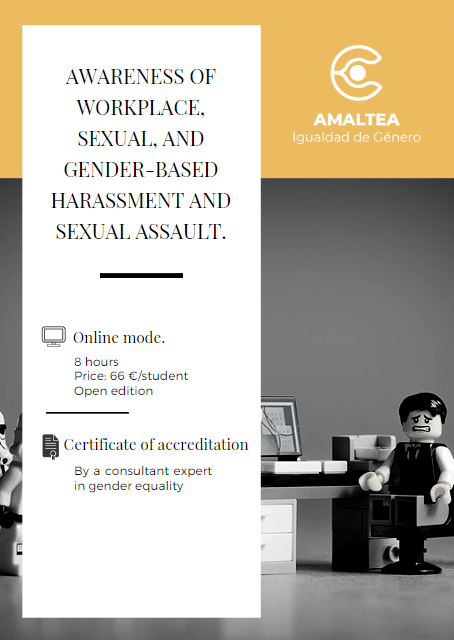
Online mode
· Duration: 8 hours
· Price: 66€/student
Certificate of accreditation
· By a consultant on gender equality and opportunities
100% refundable course
· We manage your subsidised training
Open online edition
· Course available
Teaching Guide
Module 1: What is Harassment?
- Unit 1. Workplace Harassment. Definition and indicators
Unit 2. Sexual Harassment. Definition and indicators
Unit 3. Harassment based on sex/gender. Definition and indicators
Module 2: Prevention of harassment
- Unit 4. Good Practice Protocols
Module 3. Harassment protocol
- Unit 5. Procedure
- Unit 6. Initial assessment
- Unit 7. Investigation process
- Unit 8. Investigation commission
- Unit 9. Resolution and communication
- Unit 10. Sanction
Module 4: Sexual Assaults
-
Unit 10. Organic Law on Guarantee of Sexual Freedom. Modifications and characteristics.
- Unit 11. Prevention of sexual violence.
- Unit 12. Procedures for dealing with situations of sexual assault.
GOALS
- Know how to differentiate a bullying situation from another that is not.
- Know the early indicators of a bullying situation, avoiding the aggravation of the problem.
- Detect whether it is workplace bullying, in any of its forms, or another psychosocial phenomenon (conflict, stress, burnout…)
- Know strategies to prevent the occurrence of cases of bullying.
- Identify key figures to contact in case of bullying.
- Know the procedure of action of the company in case of conducting an investigation for workplace harassment.
- Be aware of the guarantees as an employee who participates in an investigation process for harassment, and also of the corresponding sanctions that can be imposed.
- Expose the action procedure in cases of sexual harassment.
- Know the modifications and characteristics of the Organic Law of Sexual Freedom.
- Establish procedures in situations of sexual assault.