
What will I take away from the Training in Psychosocial Risks?
Psychosocial risks are increasingly present in today’s work environments, and their effects can have serious repercussions on both workers and organisations if they are not properly identified and managed.
This training offers a comprehensive overview of psychosocial risks, beginning with a conceptual approach and progressively exploring the main factors involved, such as workload, emotional demands, lack of autonomy, poor work-life balance, and job insecurity.
The course will provide participants with the tools needed to understand how these risks manifest, how they affect people’s health and wellbeing, and how they differ from other types of occupational risks. It will also address the consequences of prolonged exposure to psychosocial risks, including stress, burnout, anxiety or depression.
A key focus of the training will be the application of preventive measures at both organisational and individual levels, including recommendations for promoting a healthy psychosocial work environment. The training will also examine the current regulatory framework and the role of the company in risk assessment, planning and monitoring of preventive action.
Ultimately, the aim is to equip students with the knowledge and practical skills to identify, assess and contribute to the prevention of psychosocial risks in their workplace.
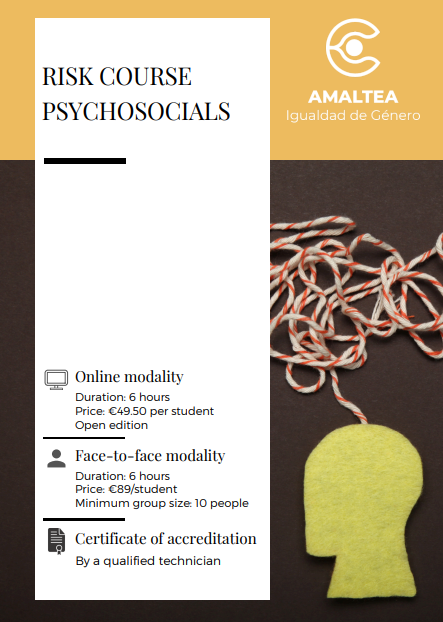
Online mode
· Duration: 6 hours
· Price: 49.50€/student
· Open edition
Face-to-face mode
· Duration: 6 hours
· Price: 89€/student.
· Minimum group size: 10 people
· Diets and travel not included
Certificate of accreditation
· By a consultant on gender equality and opportunities
100% refundable course
· We manage your subsidised training
Teaching Guide
MODULE 1 . INTRODUCTION TO PSYCHOSOCIAL RISKS
- Unit 1. Regulatory Framework.
- Unit 2. Concept and consequences.
MODULE 2. PSYCHOSOCIAL RISK FACTORS
- Unit 3. Concept and characteristics of the organization
- Unit 4. Job characteristics
- Unit 5. Work organization
- Unit 6. Working time and personal characteristics
MODULE 3. WORK STRESS
- Unit 7. Concept and consequences of work stress
- Unit 8. Stress prevention and stress intervention
MODULE 4. BURNOUT
- Unit 9. Concept of burnout
- Unit 10. Consequences, prevention and intervention in burnout
MODULE 5. HARASSMENT AT WORK
- Unit 11. Concept of harassment at work
- Unit 12. Sexual harassment and harassment based on sex/gender.
- Unit 13.Causes, phases and profiles
- Unit 14. Consequences, Prevention and Intervention of Harassment
MODULE 6. OTHER PSYCHOSOCIAL RISKS
- Unit 15. Addiction to work
- Unit 16. Technostress
MODULE 7. PSYCHOSOCIAL INTERVENTION
- Unit 17. Cognitive techniques
- Unit 18. Emotional techniques
- Unit 19. Physiological techniques
- Unit 20. Behavioral techniques
- Unit 21. Joint techniques
- Unit 22. Positive techniques
GOALS
- Understand what psychosocial risks are.
- Identify their main factors at work.
- Differentiate them from other types of occupational risks.
- Recognise their effects on mental and physical health.
- Know the applicable regulations.
- Learn how to assess them correctly.
- Apply effective preventive measures.
- Promote a healthy working environment.
- Detect signs of distress in the environment.
- Collaborate in prevention within the company.