
What will I take away from the course on workplace, sexual and gender-based harassment committees?
There are countless cases in which a case of harassment can have consequences for both the victim and the organisation itself, especially when the organisation does not have the knowledge or the means to deal with complaints.
This training will initially consist of a conceptualisation of harassment and will go into more depth about the different types of harassment that exist (workplace harassment, diversity harassment, gender harassment, etc.), differentiating them from other psychosocial risks.
In addition, the various consequences of harassment will be addressed and tools for prevention and advice will be provided for action in the event of any case of harassment. Furthermore, the regulatory framework will be explored in depth, as well as the procedure for reporting and taking action and, in turn, the procedure for coordination between companies.
In conclusion, the aim is to provide students with the knowledge and techniques to detect and prevent the types of harassment that may occur.
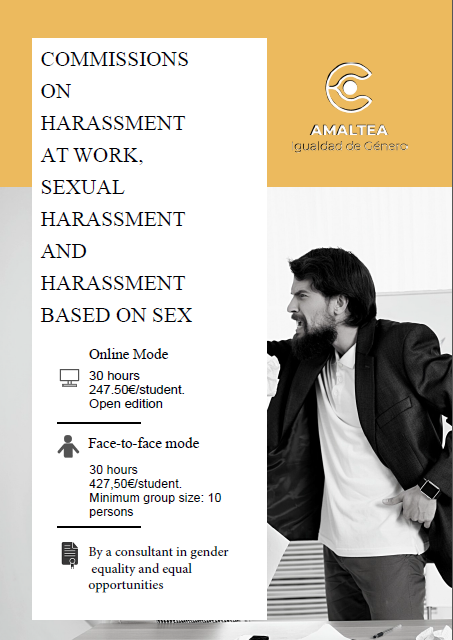
Online mode
· Duration: 30 hours
· Price: 247.50€/student
Face-to-face mode
· Duration: 30 hours
· Price: 427.50€/student.
· Minimum group size: 10
people
· Diets and travel not included
Certificate of accreditation
· By a consultant on gender equality and opportunities
100% refundable course
· We manage your subsidised training
Open online edition
· Course available
Teaching Guide
Module 1: Conceptualisation of harassment
- Unit 1. Workplace harassment. Concept and indicators.
- Unit 2. Sexual harassment. Concept and indicators.
- Unit 3. Gender-based harassment. Concept and indicators.
- Unit 4. Harassment based on gender diversity and sexual orientation.
- Unit 5. Digital harassment.
- Unit 6. Discriminatory harassment and sexual assault.
Module 2. Differential Diagnosis
- Unit 7. Differences between types of harassment and other psychosocial risks.
- Unit 8. Consequences and profiles of victim and aggressor.
- Unit 9. Prevention actions.
- Unit 10. Counselling actions.
Module 3. Action procedure
- Unit 11. Regulatory Framework
- Unit 12. Investigation Committee and procedural guarantees.
- Unit 13. Complaints procedure and courses of action.
- Unit 14. Procedure for coordination between companies.
Module 4. Investigation and intervention techniques
- Unit 15. Early detection.
- Unit 16. Assessment of workplace harassment.
- Unit 17. Assessment of sexual harassment.
- Unit 18. Interview techniques.
- Unit 19. Document management and case follow-up.
- Unit 20. Actions and intervention.
GOALS
- Understand the concept of harassment and the different types that exist.
- Be able to make a differential diagnosis between harassment and other psychosocial risks.
- Understand the antecedent causes of harassment in order to detect and prevent them.
- Be familiar with all the phases of the protocol of action in cases of workplace harassment.
- Analyse the legal bases to which our actions as a harassment committee are ascribed.
- To understand the main characteristics of bullies and victims of workplace bullying.
- To know how to use the different existing evaluation tools for bullying.